

Nail Size Chart: Penny Sizes, Lengths & Nail Gauge | Maze Nails
Sep 28th 2026
A Penny for Your Thoughts... or Your Nails? Understanding Nail Sizes and Penny Designations
Ever wondered why some nails are measured in inches while others are called 4d, 6d or 10d? This article breaks down the history behind the “penny” designation, what the “d” actually means, and how these traditional measurements relate to the nails you use every day. By the end, you’ll have a better understanding of nail sizing, and maybe even a little fun trivia to share the next time someone asks, “What the heck is a 10d nail?”
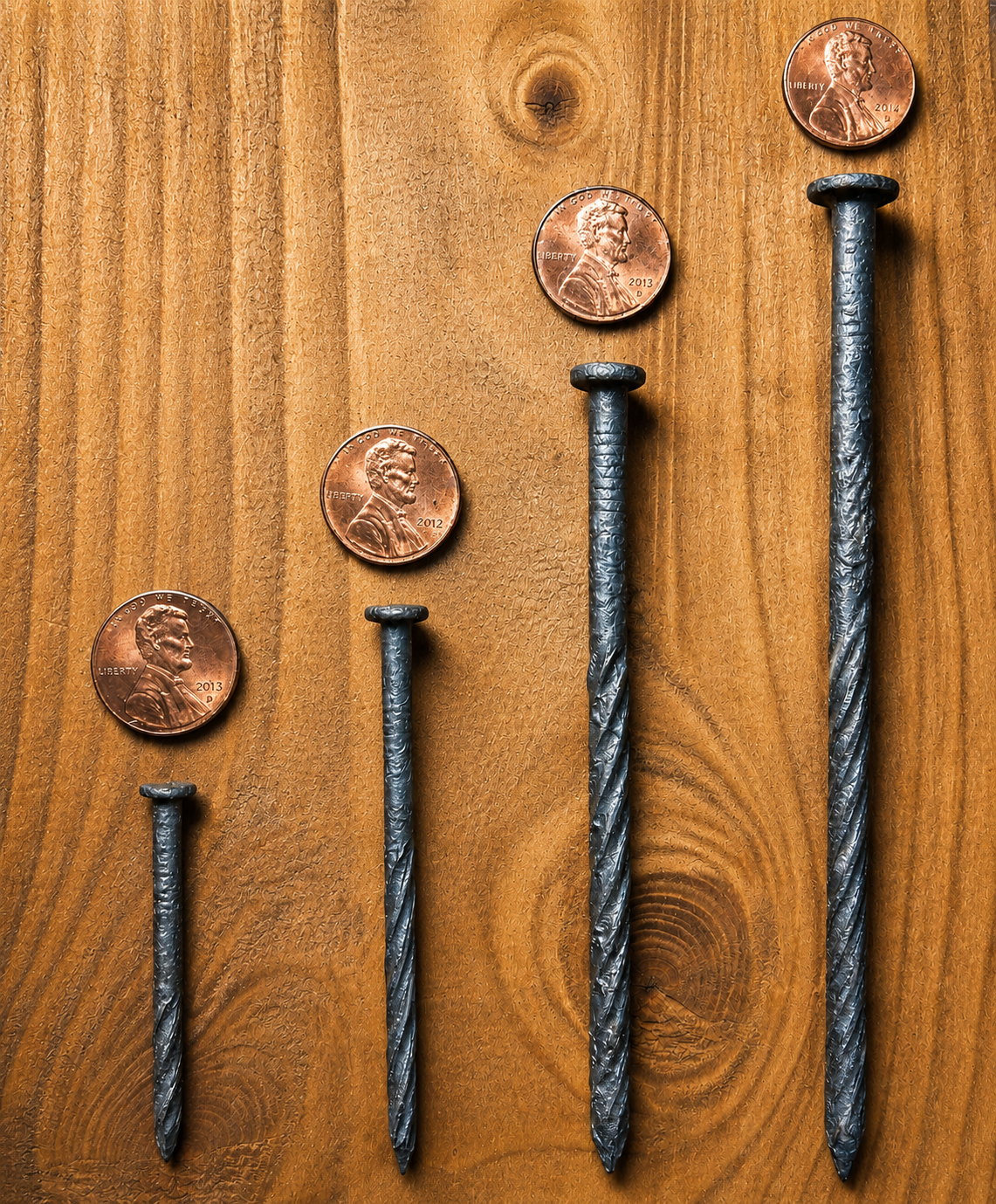
I need a 2” nail…or is that a 6-penny… or 6d?!? Why the heck do nails get measured in “pennies” (sometimes), what does the “d” mean, and why does it feel like understanding nail designations should have been a foreign language class in high school?
If you've spent any time shopping for nails, you've probably noticed that some are identified by a penny designation, such as 4d, 6d or 10d, while others are simply labeled by their length in inches.
So, what's the difference?
Penny or Inches?
In most cases, nails used for wood to wood applications are traditionally identified using the penny designation. Think wood siding, cedar shingles, cedar shakes, framing and other common woodworking and construction applications.
You'll often see these nails designated as 4d, 5d, 6d, 8d, 10d and so on.
If a nail is specified by its actual length in inches, say 1½", 2" or 2½", there's a good chance it's intended for a non wood application, such as fiber cement siding, metal roofing, asphalt shingles, cellular PVC trim and more.
Of course, there are exceptions to every rule, but this is a good general guideline when you're trying to figure out what those numbers and letters on the box actually

mean.
So, Why Are Nail Sizes measured in "Pennies"?
Now that we've cleared that up, why the heck are we calling nails “penny” in the first place?
There are a couple of commonly cited theories about where the penny system came from.
One theory is that the designation was based on the cost of nails. For example, 100 8-penny nails would have historically cost 8 pence, while 100 6-penny nails would have cost 6 pence.
Another theory ties
the designation to the weight of the nails. Under this explanation, 1,000 8-penny nails weighed approximately 8 pounds, while 1,000 6-p
enny nails weighe
d approximately 6 pounds.
Regardless of which explanation you subscribe to, the penny system dates back centuries and has stuck around as a traditional way of identifying nail sizes.
And What Does the "D" Mean?
This is where things get a little more interesting.
The “d” in 6d, 8d, 10d and other penny designations is generally associated with the denarius, an ancient Roman coin. Over time, the abbreviation “d” became associated with the British penny, or pence, and eventually found its way into the traditional system used to identify nail sizes.
So, no, the “
d” doesn't mean diameter, and it isn't some secret nail-manufacturing code.
It's just another little piece of history that has managed to stick around.
How Long Is a Penny Nail?
One of the confusing parts of the penny system is that the number doesn't directly tell you the length of the nail in inches.
Example Nail Size Chart
| Penny Size | Nail Length |
|---|---|
| 2d | 1" |
| 3d | 1-1/4" |
| 4d | 1-1/2" |
| 5d | 1-3/4" |
| 6d | 2" |
| 7d | 2-1/4" |
| 8d | 2-1/2" |
| 9d | 2-3/4" |
| 10d | 3" |
| 12d | 3-1/4" |
| 16d | 3-1/2" |
| 20d | 4" |
| 30d | 4-1/2" |
| 40d | 5" |
| 50d | 5-1/2" |
| 60d | 6" |
| 70d | 7" |
| 80d | 8" |
But knowing the designation is only half the battle when it comes to selecting the right nail. One thing to always keep in mind for the best holding power is that your nail should penetrate approximately 1¼" into the material you’re fastening.
Keep in mind t
hat nail diameter and exact specifications can vary by nail type, so the penny designation shouldn't be used as a substitute for checking the actual product specifications.
A Little History in Every Box
The next time you see a box of 8d nails, you'll know there's a lot more behind that little “8d” than meets the eye.
At Maze Nails, we've been making high-quality nails to meet your construction needs for more th
an 175 years. While that's a long time, the penny system has been around even longer!
Whether you have questions about a little nail history trivia or you're trying to figure out which nail is right for your project, our knowledgeable and friendly team at Maze Nails is here to help.
Give us a call at 1-800-435-5949. We're happy to help you “nail” down the answer!